Visibly Wet for 10 Minutes: Why Contact Time Is the Whole Game
Last reviewed 2026-08-20
Watch anyone clean: spray, wipe, done — eight seconds. Now read any EPA disinfectant label: “treated surfaces must remain visibly wet for 10 minutes.” The gap between those two numbers is where most “disinfected” surfaces actually aren’t.
What contact time really is
Disinfection is chemistry, and chemistry takes time. Quat molecules must find microbes, bind to their membranes, and break them — millions of times over, across every square inch. The EPA efficacy test that earns a label claim runs for a fixed wet-dwell period; pass at 10 minutes and the label says 10 minutes. The claim literally does not exist at 8 seconds.
ArkGuard’s times, straight from the label:
| Claim | Contact time |
|---|---|
| Disinfection (bacteria, fungi), virucidal claims, parvo/rabies at 9 oz/gal | 10 minutes |
| Non-food-contact sanitizing | 3 minutes |
| HIV-1 / SARS-CoV-2 | 2 minutes |
| Mildew control | wet application, reapply every 7 days |
“Visibly wet” is the operative phrase
Not damp. Not recently sprayed. Visibly wet — you can see the sheen. The moment a surface flashes dry, the clock stops. Warm concrete in the sun, airflow from kennel fans, and porous grout lines all steal your dwell time.
Four ways working facilities actually hit 10 minutes:
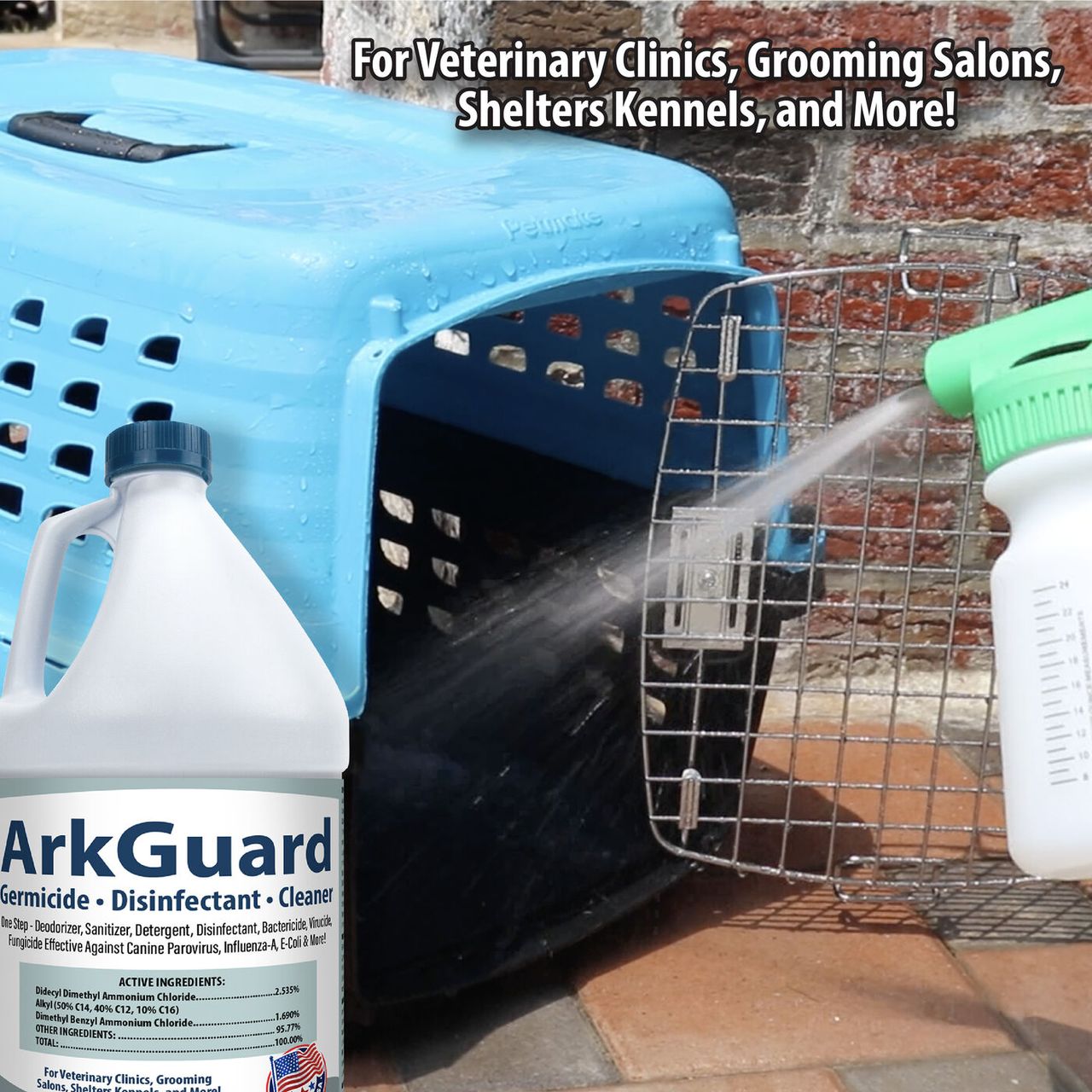
- Wet heavier than feels natural. A coarse spray to the point of near-runoff lasts far longer than a fine mist. The pump sprayer’s coarse setting exists for this.
- Work in zones. Spray kennels 1–6, go back and re-mist 1 as needed, then rinse-critical items. Sequencing buys dwell time without standing around.
- Time it once. Literally watch one kennel with a phone timer on a hot day. Most teams are shocked how fast 10 minutes isn’t.
- Re-wet without guilt. A second pass at minute six costs pennies. A parvo case costs thousands.
Why spray-and-wipe survives anyway
Because it looks clean, and cleaning is visible while microbiology isn’t. To be fair, spray-and-wipe is cleaning — soil removal matters and is required before disinfection. The mistake is stopping there on surfaces that need a kill: intake kennels, isolation, grooming tables between dogs, anything after a sick animal.
Routine wipe-downs for appearance: fine. Disinfection: wet, and stay wet.
The takeaway
Every dilution on the ArkGuard chart is half of an ordered pair — ratio and time. 2 oz/gal for 10 minutes. 9 oz/gal for 10 minutes. Honor both numbers and the label’s kill list is yours; honor one and you’re just spraying water.
Frequently asked
What does contact time mean on a disinfectant label?
The number of minutes a surface must stay visibly wet with solution for the product to achieve its tested kill. For ArkGuard's disinfection claims it is 10 minutes; sanitizing claims are 3 minutes; HIV-1 and SARS-CoV-2 are 2 minutes.
What if the surface dries before the time is up?
Re-apply. Once the film dries, killing stops. Mist the surface again until total visible wetness reaches the labeled time.
Is a longer contact time better?
Meeting the label is what matters. Letting solution sit wet beyond the labeled time is fine on hard non-porous surfaces, but the tested claim is achieved at the stated time.