Can You Mix ArkGuard With Other Cleaners? (No — Here's Why)
Last reviewed 2026-08-20
Every facility has one bottle of something that gets “boosted” into everything else. This page exists to keep ArkGuard out of that bottle. The short answer is mix ArkGuard with water and nothing else — and the reasons are chemistry, safety, and law.
The chemistry: soaps switch quats off
ArkGuard’s actives are quaternary ammonium compounds — positively charged molecules that attack microbial membranes. Most detergents are anionic: negatively charged. Put them in the same bucket and they find each other before they find any germs, pairing up into an inert complex. The solution still foams, still smells like cleaning — and disinfects like water.
This is also why the funnel stays clipped to its jug, why buckets get rinsed between products, and why “a splash of dish soap for suds” is the quietest way to ruin a disinfection program.
The safety line: bleach is not a booster
Mixing chemistries you don’t control is how cleaning closets send people to urgent care. Bleach plus acids makes chlorine gas; bleach plus ammonia-family products makes chloramines. Beyond the danger, any additive voids the tested formula: ArkGuard’s efficacy data — the reason it’s EPA-registered at all — was generated at label dilutions in plain water (tested at 400 ppm hard water and 5% soil, so real-world conditions are already baked in).
And it’s not just advice: the label states it is a violation of Federal law to use the product in a manner inconsistent with its labeling.
The right way to handle a filthy surface
What people are usually reaching for when they mix is more cleaning power. The label already provides it, in two steps:
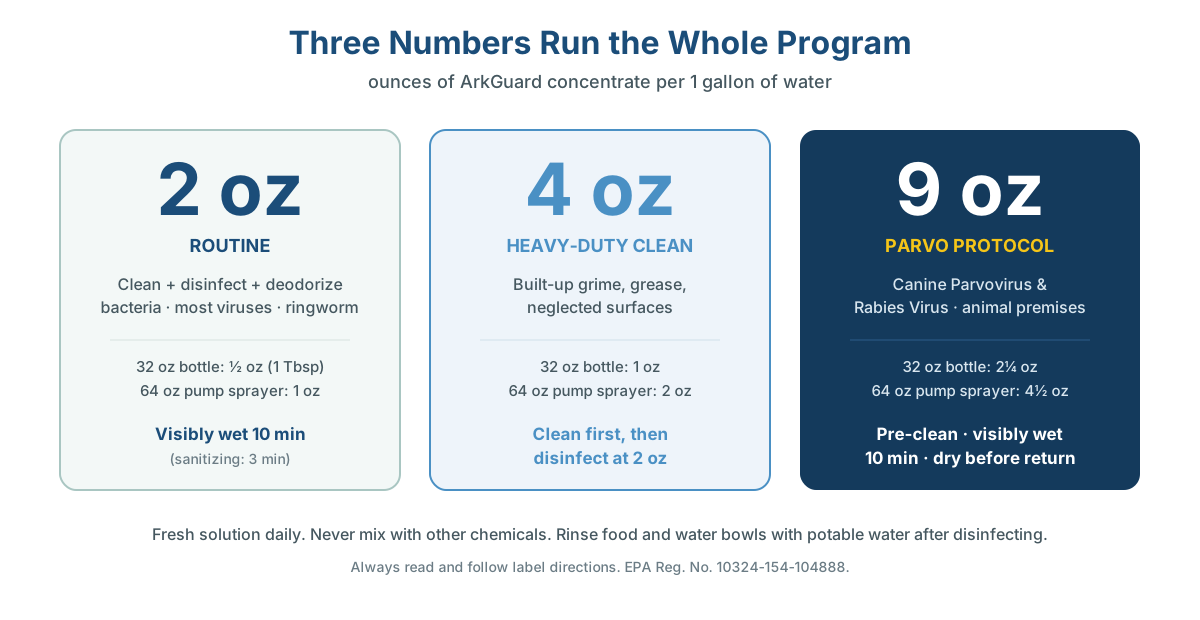
- Clean. Use ArkGuard itself at the heavy-duty 4 oz/gal rate to strip grease and grime — it is a detergent as well as a disinfectant. Scrape and remove solids first.
- Disinfect. Apply fresh 2 oz/gal solution (or the 9 oz/gal parvo protocol where indicated) and keep the surface visibly wet for 10 minutes.
Two passes from one jug — no cocktail required.
What about odor products, enzymes, and deodorizers?
ArkGuard deodorizes as it disinfects because it kills the odor-producing bacteria. If you also use an enzyme or odor product for soaked-in organic messes, use it separately — different day or fully rinsed surface — never blended into the same solution, and never immediately before disinfecting (enzyme products are proteins; a disinfectant shuts them down, and residues cut both ways).
One product, one bucket, label dilution, full contact time. That’s the whole trick.
Frequently asked
Can I add a little bleach to make ArkGuard stronger?
Never. Mixing chemistries is dangerous and can create irritating or toxic byproducts, and it destroys the EPA-tested formula. Use ArkGuard exactly as labeled, at label dilutions, with nothing added.
Can I mop with ArkGuard and a floor soap together?
No. Detergents — especially anionic ones, which is most soaps — bind and deactivate quaternary ammonium actives. Clean first if the floor is filthy, rinse, then disinfect with ArkGuard alone.
Is ArkGuard a cleaner on its own?
Yes. It is a one-step detergent, cleaner, and disinfectant — for ordinary soil you don't need a separate soap at all. Heavy grime gets the 4 oz/gal heavy-duty rate first.