The Kennel Cleaning Routine: Daily, Weekly & Turnover Protocols
Last reviewed 2026-08-20
A kennel that smells clean at 8 a.m. and stays healthy through parvo season doesn’t get there on effort — it gets there on sequence. This is a complete program you can print, train, and inspect, built directly on the ArkGuard label.
The daily pass (occupied runs)
Morning, after the first yard rotation:
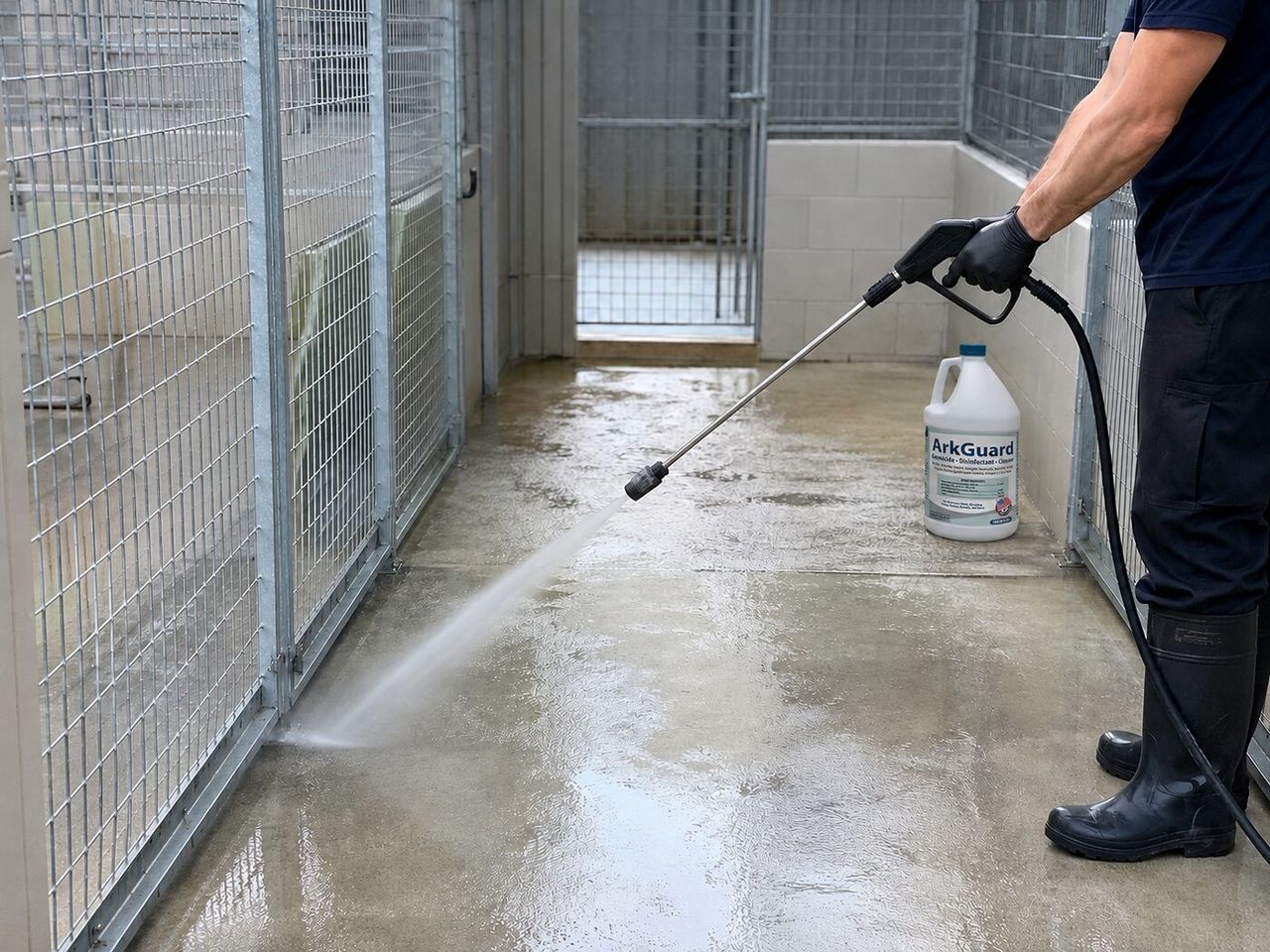
- Dogs out, bowls out, bedding out. The label requires animals and feed removed before treatment — and it’s faster anyway.
- Solids first. Scoop, scrape, squeegee to the drain. Disinfectant poured over feces is wasted disinfectant.
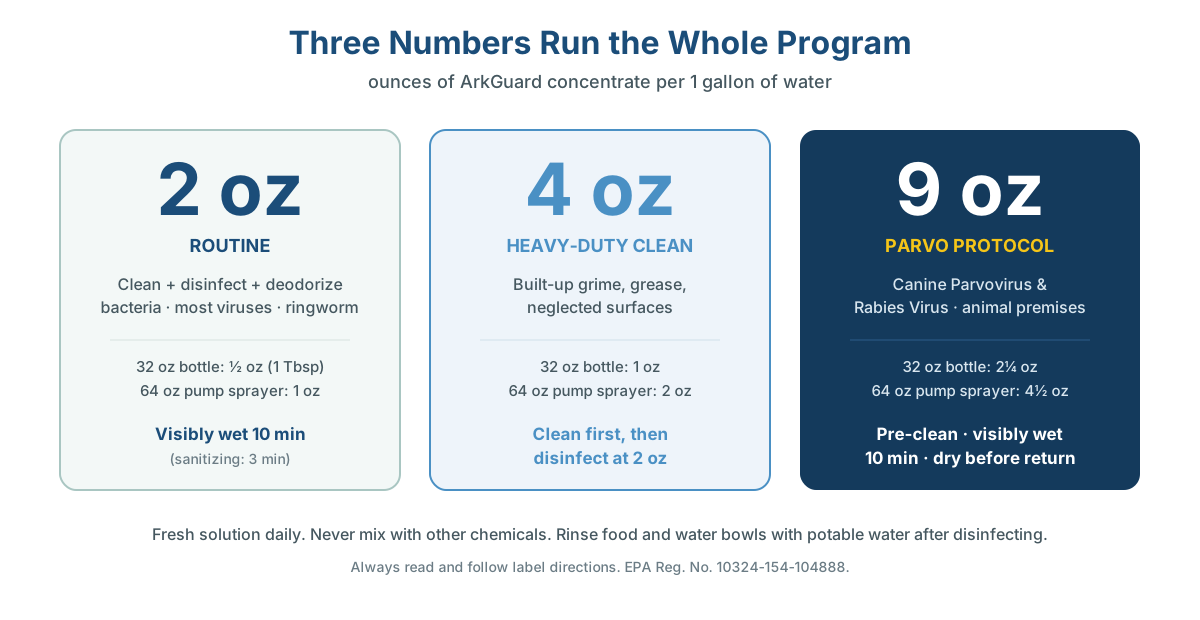
- Wash. ArkGuard at 2 oz/gal — mop or pump sprayer — floor, lower walls, bars, latch.
- Wet 10 minutes. Do the next run while this one dwells; re-wet what flashes dry.
- Dry, then restore. Squeegee excess, air dry, bedding back, bowls washed and potable-rinsed, dog back.
A two-person team doing runs in leapfrog sequence hits the contact time with zero standing around — that’s the labor math that makes daily disinfection actually happen.
Kennel turnover (between dogs)
Every departure is a mini-outbreak drill, because the next dog’s immune history is unknown:
- Strip everything, including toys and platforms. Hard toys and bowls get washed, disinfected, and potable-rinsed; soft items get laundered hot or discarded.
- Clean at 4 oz/gal if the run is grimy; otherwise straight to disinfection.
- Disinfect 2 oz/gal, 10 minutes wet — floor, all four walls to splash height, bars, ceiling of the enclosure if solid, resting bench, door hardware inside and out.
- Dry fully before the new dog enters.
Known or suspected disease exposure? Run the 9 oz/gal parvo protocol instead, and treat the gear that traveled with the dog.
The weekly deep clean
Once a week, the stuff daily passes skip:
- Drains: covers pulled, baskets emptied, first section brushed with 2 oz/gal solution — the number-one odor and biofilm reservoir in any kennel.
- Walls to ceiling height, fan guards, light switches, door push plates.
- Equipment soak: scrapers, squeegees, brushes, halters immersed in 2 oz/gal solution (the label covers immersion), then air-dried.
- Mop heads and towels hot-laundered; mop buckets scrubbed and stored dry.
- Foot baths refreshed: 2–4 oz/gal, one inch deep at every entry during disease season, and remade daily or when visibly dirty (that schedule is on the label too).
Isolation: the upgrade kit
Isolation runs get their own labeled sprayer, their own scraper and squeegee that never leave the room, disposable or dedicated PPE, disinfection between every entry rather than daily, and the parvo-strength mix standing ready. Cross-traffic — tools, boots, hands — is how isolation fails; the chemistry is the easy part.
Post it
The printable dilution chart covers the numbers; this page covers the order. Train the sequence, audit with a timer once a month, and your kennel will pass the smell test and the swab test on the same day.
Frequently asked
How often should a kennel be disinfected?
Occupied runs get a daily clean-and-disinfect pass; every kennel gets a full disinfection at turnover before a new dog moves in; the facility gets a weekly deep clean of walls, drains, and equipment. Isolation areas are disinfected between every entry.
Should dogs be in the kennel while I clean?
No. The label requires removing animals and feed from the area before application, keeping surfaces visibly wet 10 minutes, and letting everything dry before animals return.
What's the right dilution for daily kennel cleaning?
2 oz per gallon for the routine one-step clean, disinfect and deodorize. Step up to 9 oz per gallon only for the parvovirus/rabies protocol, and 4 oz per gallon for heavy-duty grime removal.