Sealed vs. Unsealed Concrete: The Most Important Floor Decision in Animal Care
Last reviewed 2026-08-20
Two kennels buy the same disinfectant, run the same protocol, and get different disease years. Look down: the difference is usually the floor. Concrete is either a hard, non-porous surface the label fully covers, or a sponge with a reputation — and which one you own is a decision, not a fact of nature.
Why porosity decides everything
A disinfection claim is a wet film held on a surface for a measured time (the contact-time rule). Bare concrete is a network of capillary pores: pour solution on it and the film disappears into the slab in seconds, taking your contact time with it — while urine, organics, and pathogens that soaked in earlier sit safely below chemical reach. That’s why parvo haunts old bare-slab kennels: the slab itself is the reservoir (parvo’s environmental persistence plus a protective matrix).
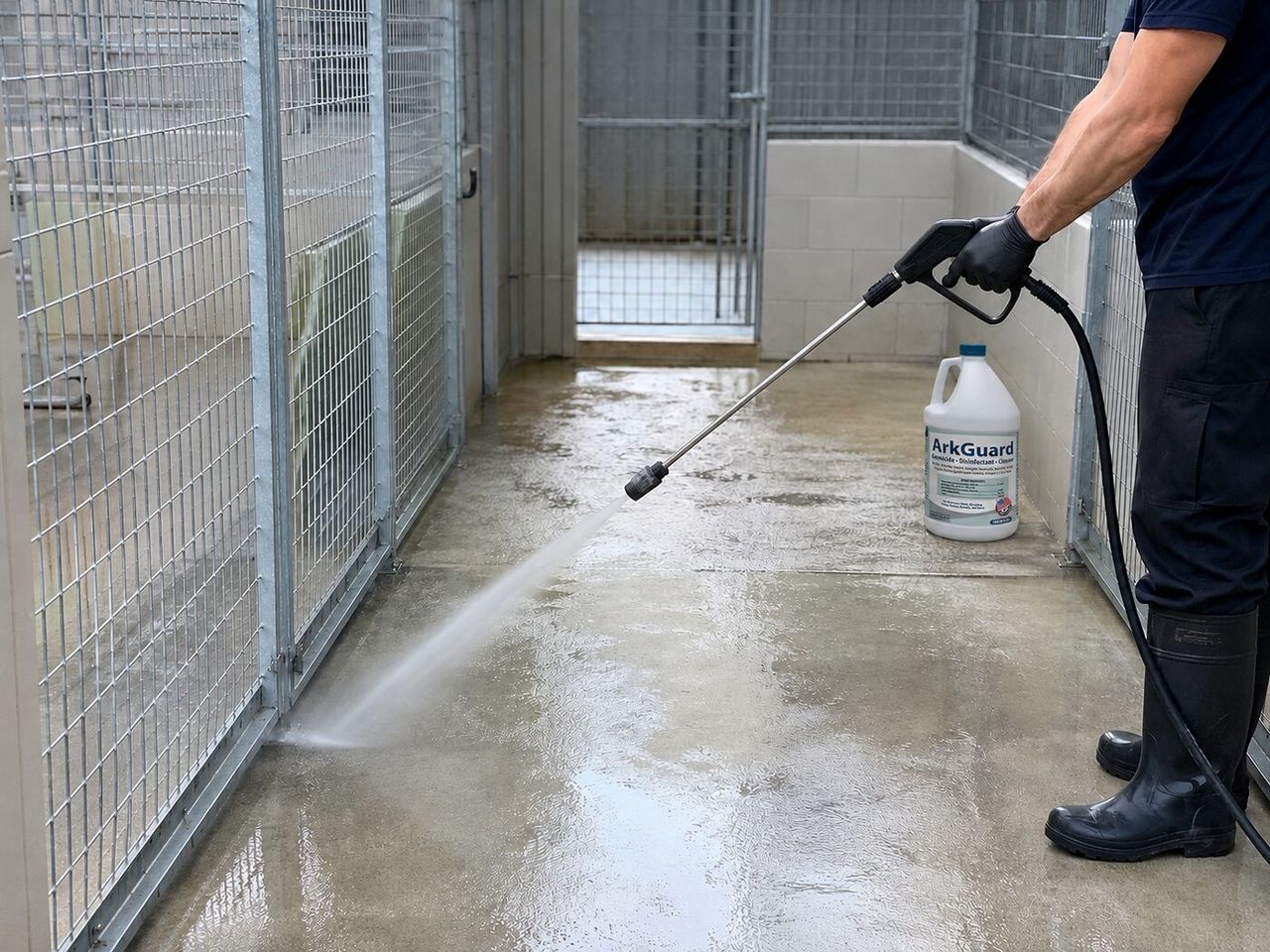
Sealed concrete flips every variable: solution stays on top holding its wet time, urine stops soaking in, odor stops accumulating, and the squeegee actually removes what you put down.
The 60-second water-drop test
On clean, dry slab: pour a small puddle. Beads or stands for several minutes → sealed — run the standard program with confidence. Darkens and drinks in under a couple of minutes → porous — your “disinfection” has been partial at best, and sealing should move up the project list. Test several spots; traffic lanes wear sealer off first.
Sealing: the highest-ROI project in animal housing
For a kennel, garage dog zone, or run pad, the ladder runs: penetrating siliconate/silane sealers (cheap, invisible, good start), acrylic film sealers (better sheen and cleanability, periodic recoat), and epoxy/polyurea coatings (the facility-grade answer — seamless, chemical- rated, decades of mop cycles). Whatever the choice: add traction grit (wet sealed floors are slick under paws), cove the wall-floor joint if you can (the odor seam disappears), slope to drains, and respect full cure time before animals return.
From sealing day forward, the floor joins the label: 2 oz/gal routine, 9 oz/gal parvo protocol, 10 minutes visibly wet, squeegee, dry, done — same as any kennel surface.
Managing bare concrete until then
Honesty for the meantime: scrape and remove all organics fast (less soaks in), wash with ArkGuard at the 4 oz/gal heavy-duty cleaning rate — cleaning still removes enormous microbial load even where the disinfection claim can’t attach — dry aggressively, and treat the slab as suspect ground for unvaccinated animals after any disease event. Then seal it, and retire this paragraph.
Frequently asked
Can you disinfect bare concrete?
Not reliably — bare concrete is porous, drinking solution below the surface where no wet contact time can be held, so disinfection claims apply only to hard, non-porous (sealed) surfaces. Cleaning helps; the tested kill requires a sealed floor.
How do I know if my concrete is sealed?
The water-drop test: pour a few tablespoons of water on the clean, dry slab. If it beads or sits on the surface for minutes, it's sealed; if it darkens and soaks in within a minute or two, it's porous and due for sealing.
What sealer should a kennel use?
For animal areas, the common choices are penetrating sealers topped with a film-forming finish, or epoxy/polyurea coatings for heavy-duty floors. Choose a product rated for wet cleaning and chemical exposure, with texture added for traction — and follow its cure time before animals return.