
The Garage Dog Zone: Kennels, Wash Stations & Concrete Done Right
Last reviewed 2026-08-20
The garage is America’s default kennel annex: the crate bank, the recovery pen for a surgery dog, the muddy-season wash station, the whelping overflow. It can be the cleanest room a dog uses — concrete, drains, no carpet — or the dirtiest, depending on three decisions.
Decision 1: seal the floor
Everything hinges on this. Bare concrete is porous — urine and germs sink below where any disinfectant can hold a wet contact time, so label claims genuinely don’t apply (the concrete deep-dive). A weekend epoxy or concrete-sealer job converts the dog corner into a hard, non-porous surface, and from that day the standard program works: sweep, wash at 2 oz/gal, keep visibly wet 10 minutes, squeegee toward the drain, air dry. Bonus: sealed floors stop absorbing odor, which is why the garage stops smelling like the garage.
Decision 2: dedicate the zone and the tools
Chalk-line the dog zone mentally: crates, wash station, food bin shelf, gear hooks — and give it its own mop, bucket, and squeegee. Crates on the concrete follow the standard crate protocol; raise them on furring strips or a mat so floor washes can run beneath. If there’s a floor drain, it’s your best friend and your weekly scrub target — garage drains grow the same biofilm kennel drains do.
A wash station is just a corner with water access and slope: bathe the dog with dog shampoo (ArkGuard never touches animals), then when the dog’s gone, treat the splash zone — floor, lower wall, tub or basin — with the 2 oz/gal mix.
Decision 3: respect the chemical shelf
Garages hold the most dangerous mixing partners in the house: pool chlorine, degreasers, fertilizer, gasoline. The rules: ArkGuard stays in its original labeled container, tightly closed, off the floor, on a different shelf from oxidizers and acids, out of reach of kids and dogs, and protected from freezing (concentrate that freezes and thaws should be replaced — and a frozen puddle of solution never disinfected anything). Mixed solution lives in labeled spray bottles only — an anonymous jug of mystery solution in a garage is an accident with a timer. And nothing ever gets blended, not even to “boost” a stubborn stain.
The seasonal rhythm
Weekly: crate pans, wash-station splash zone, gear-hook wall, spot-mop. Monthly: full floor wash, drain scrub, door-bottom and threshold (the mud gateway). Event-driven: the whole zone after a sick dog, a foster stay, or flood water — flood-touched surfaces get the heavy-duty clean at 4 oz/gal, then the disinfection pass.
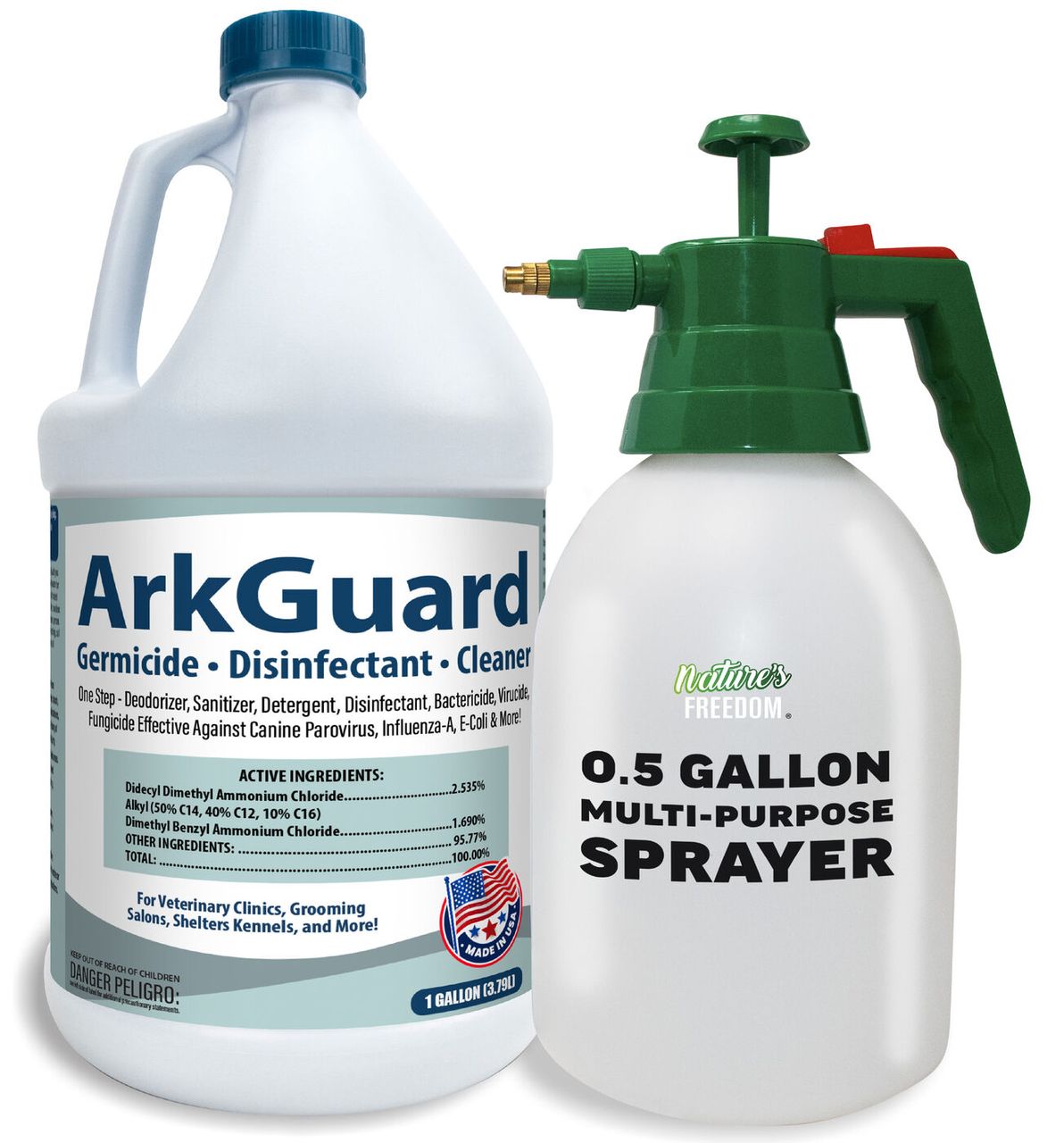
For garage-kennel setups bigger than a hobby — sport-dog rigs, hunting kennels, rescue overflow — the gallon with pump sprayer is the right scale.
Frequently asked
Can I disinfect a bare garage floor?
Bare concrete is porous, so disinfection claims don't apply to it. Seal or epoxy-coat the dog zone first — then it's a hard, non-porous surface that takes the full 2 oz/gal, 10-minute protocol like a kennel floor.
Where should I store the disinfectant in a garage?
In its original container, tightly closed, off the floor, away from food and feed, and nowhere near freeze temperatures or the car-chemical shelf. Never transfer concentrate into unlabeled jugs.
Can the garage dog area share the mop with the house?
Give the dog zone its own mop, bucket, and squeegee. Cross-using tools moves soil and chemistry both directions — dedicated tools are cheap and end the question.