Rubber Mats & Kennel Flooring Systems: Both Sides, Every Time
Last reviewed 2026-08-20
Rubber mats solve real problems — joint comfort, traction, insulation from cold slab — and create exactly one: the underside. Moisture wicks beneath, never sees light or airflow, and quietly builds the bacterial layer that makes a room smell like the mats themselves. The whole art of mat floors is refusing to pretend the bottom face isn’t there.
Know your mat
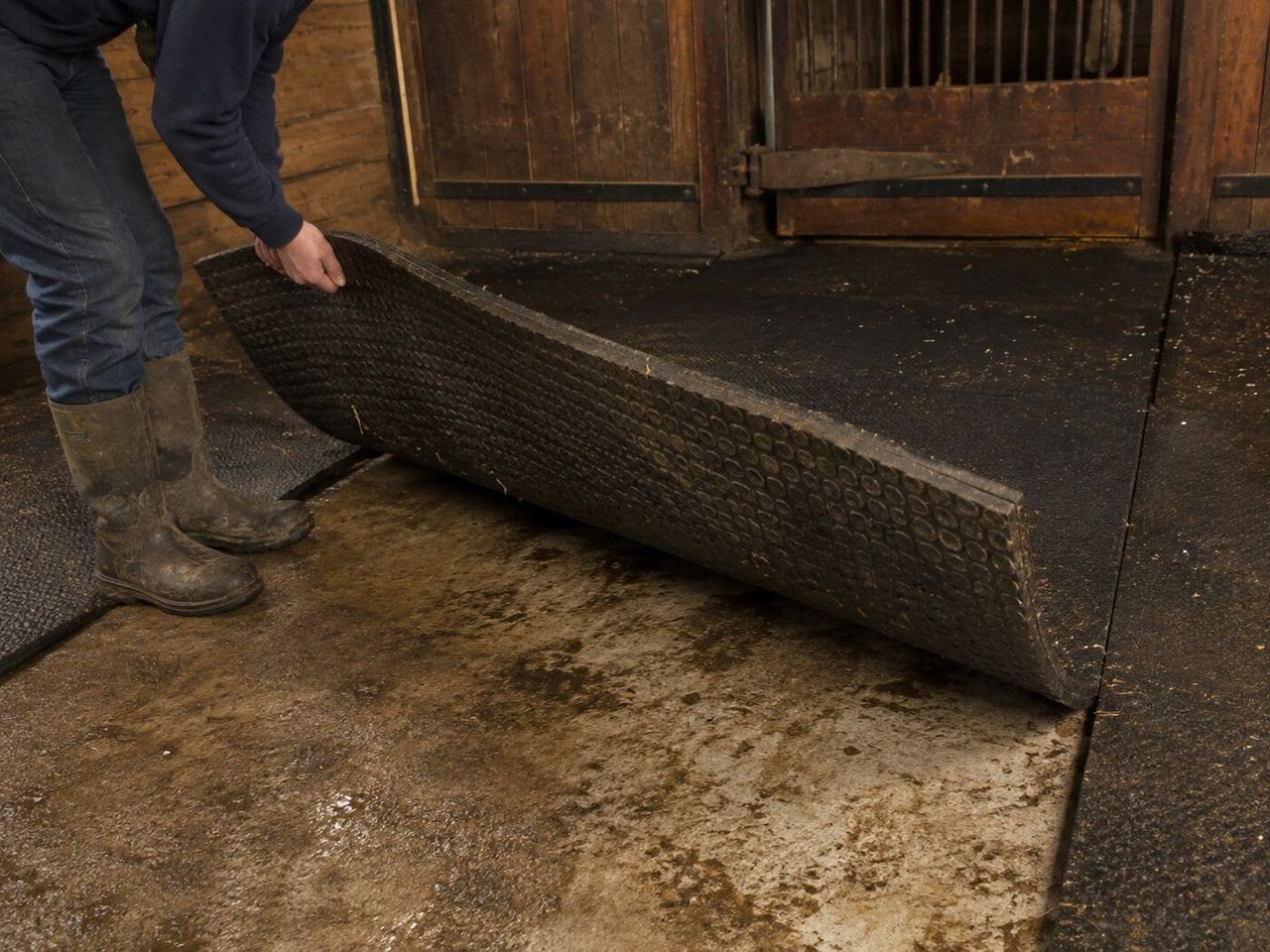
Solid rubber (stall mats): dense, non-porous surface — fully disinfectable on both faces. Heavy, so build the flip into the schedule realistically. Foam/EVA puzzle tiles: closed- cell surfaces wipe fine, but cut edges and any gouges expose absorbent core — treat damaged tiles as porous and retire them. Raised perforated kennel deck: drains beautifully, dries fast, and hides its soil on pegs and rails below — different geometry, same underside rule.
The fingernail test on any mat: if the surface is intact and water beads, the label’s hard-non-porous protocol applies. Torn, cracked, or sponge-cored: it’s bedding, not flooring, and no spray fixes it.
The daily surface pass
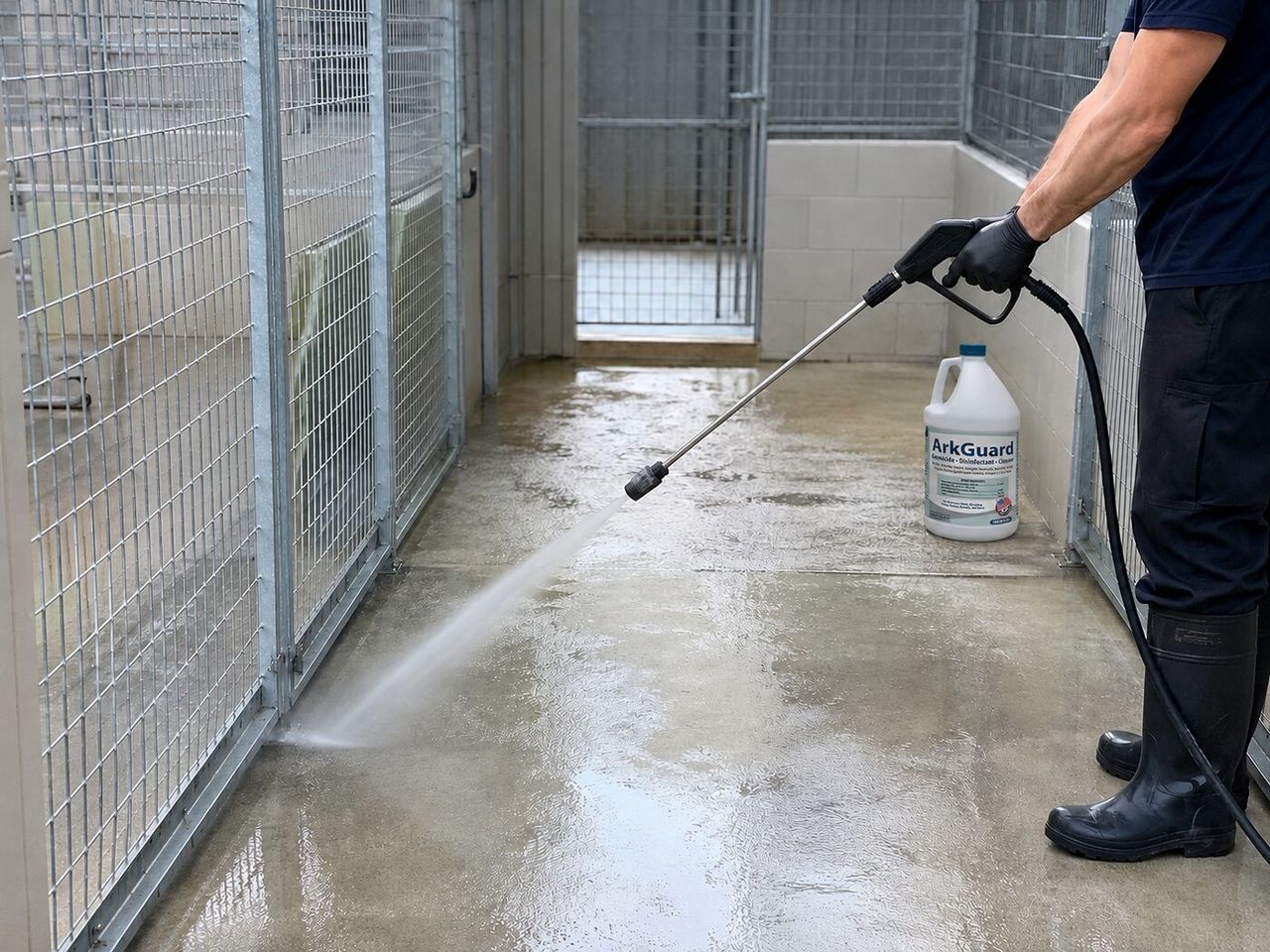
With mats in place: solids off, wash the top face at 2 oz/gal with the pump sprayer or mop, keep visibly wet 10 minutes, squeegee, air dry before the dog returns. Textured mat surfaces need a touch more solution than smooth floor — the peaks shed liquid into the valleys, so wet generously enough that the whole profile stays glossy through the dwell.
The weekly flip (the part that matters)
Mats up and out — leaned against the kennel wall or fence in the sun. Then three treatments:
- Mat top: heavy-duty clean at 4 oz/gal if grimy, then 2 oz/gal disinfection, 10 minutes.
- Mat bottom: the same, with extra attention — this face has been composting all week.
- The slab beneath: wash, disinfect, squeegee — this is also your sealed-concrete checkpoint; if the hidden slab is bare and drinking moisture, the mat has been incubating a reservoir you can’t spray away.
Everything fully dry before reassembly — trapping moisture under a freshly disinfected mat just restarts the experiment with cleaner inputs. Sun-drying adds free UV and is the single best-smelling decision in kennel keeping.
Deck tiles and edges
Interlocking systems: disassemble a section per week on rotation, treat tiles top and bottom (a soak tub works — the label covers immersion), scrub the pegs and the slab, dry, rebuild. Edges and seams are where odor lives in tile systems; the soak handles what a surface spray can’t reach on geometry alone.
Mat-heavy facilities burn solution faster than anyone — the gallon program at 64 diluted gallons per jug is priced for exactly this workload.
Frequently asked
Can rubber stall mats be disinfected?
Solid rubber mats have a non-porous surface that takes the 2 oz/gal, 10-minute protocol — but only if you treat both faces and the floor beneath. The trapped zone under a mat is where mat floors fail.
How often should kennel mats be flipped and treated?
Weekly for occupied runs: mats up, both faces washed and disinfected, the slab beneath treated, everything dried before reassembly. Daily surface passes in between.
Are interlocking deck tiles better than solid mats?
Raised, perforated kennel deck drains better and dries faster, but every edge and peg is a soil trap — they need periodic disassembly for the same both-sides treatment. Either system works if the underside schedule is honored; neither survives being ignored.