
Foot Baths & Entryway Stations: Stopping Disease at the Door
Last reviewed 2026-08-20
Almost everything that infects a kennel arrives at ankle height. Parvo rides sidewalk grime, kennel cough rides the boarding lobby, barn bugs commute between buildings on boots — which is why the humble foot bath, done to spec, is the highest-leverage square foot in biosecurity. Done off-spec, it’s a puddle that makes people feel better. The spec is short; here it is.
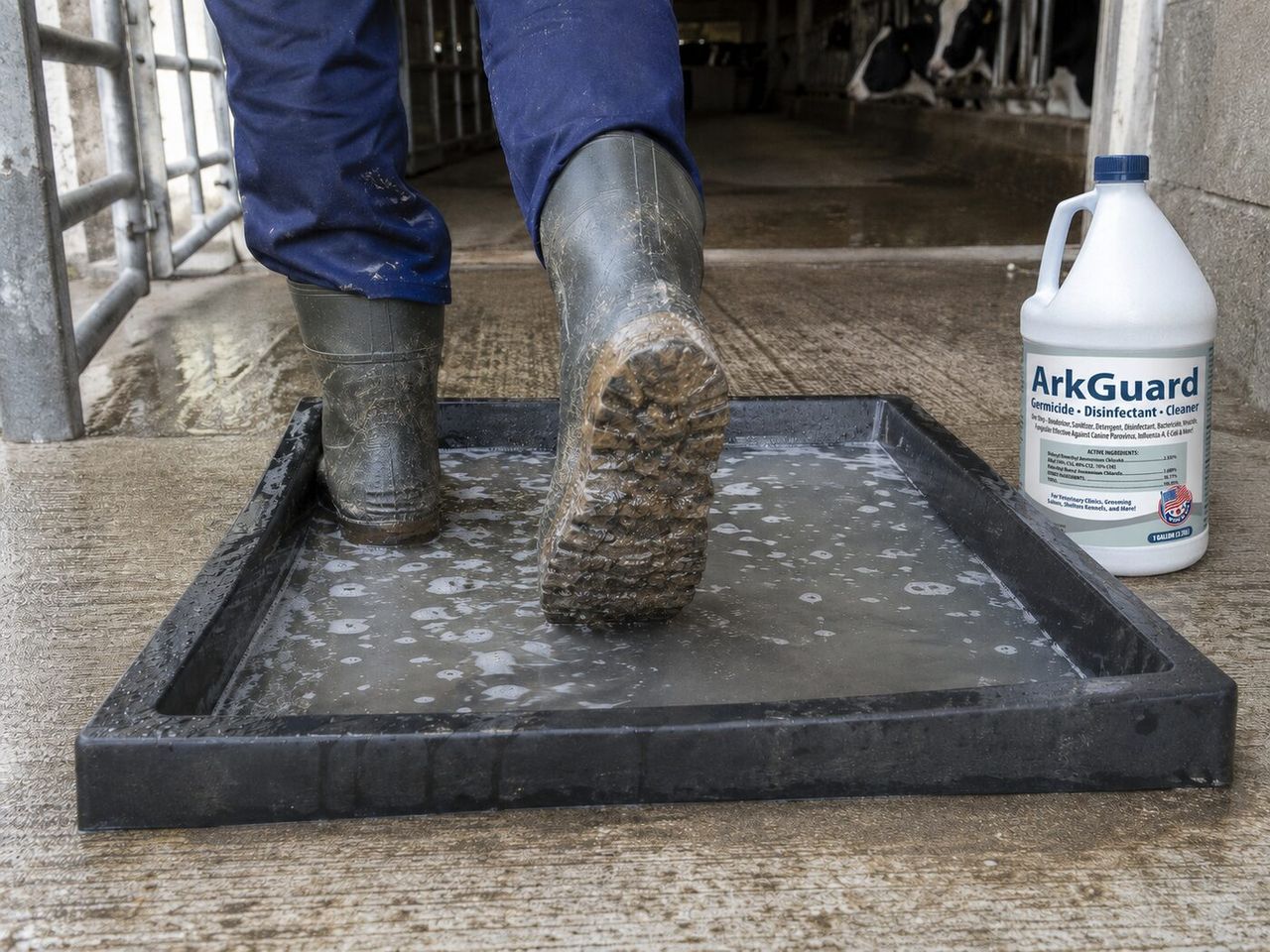
The label’s recipe
- Mix: 2–4 oz of ArkGuard per gallon of water (use the top of the range for high-traffic or outbreak conditions).
- Depth: maintain one inch of solution — enough to wet the full tread.
- Prep: a scrape mat or boot brush before the pan. Organic load is the enemy of every disinfectant; a bath full of scraped-off mud is a soil-deactivated bath.
- Contact: stand or shuffle for about 3 minutes for the sanitizing effect the label describes. In practice: place the bath where people naturally pause — inside a door that closes behind them — not where they leap it in stride.
- Remake daily, or when visibly dirty. This is the make-or-break line. A Monday bath on Thursday is worse than nothing, because it certifies dirty boots as clean.
The label also covers foam entry systems — a half-inch to two-inch foam layer at 2–4 oz/gal across an entry zone, walked through and refreshed daily — the industrial version for hatcheries, food-adjacent facilities, and big barn doors. Never add other foam products to the solution.
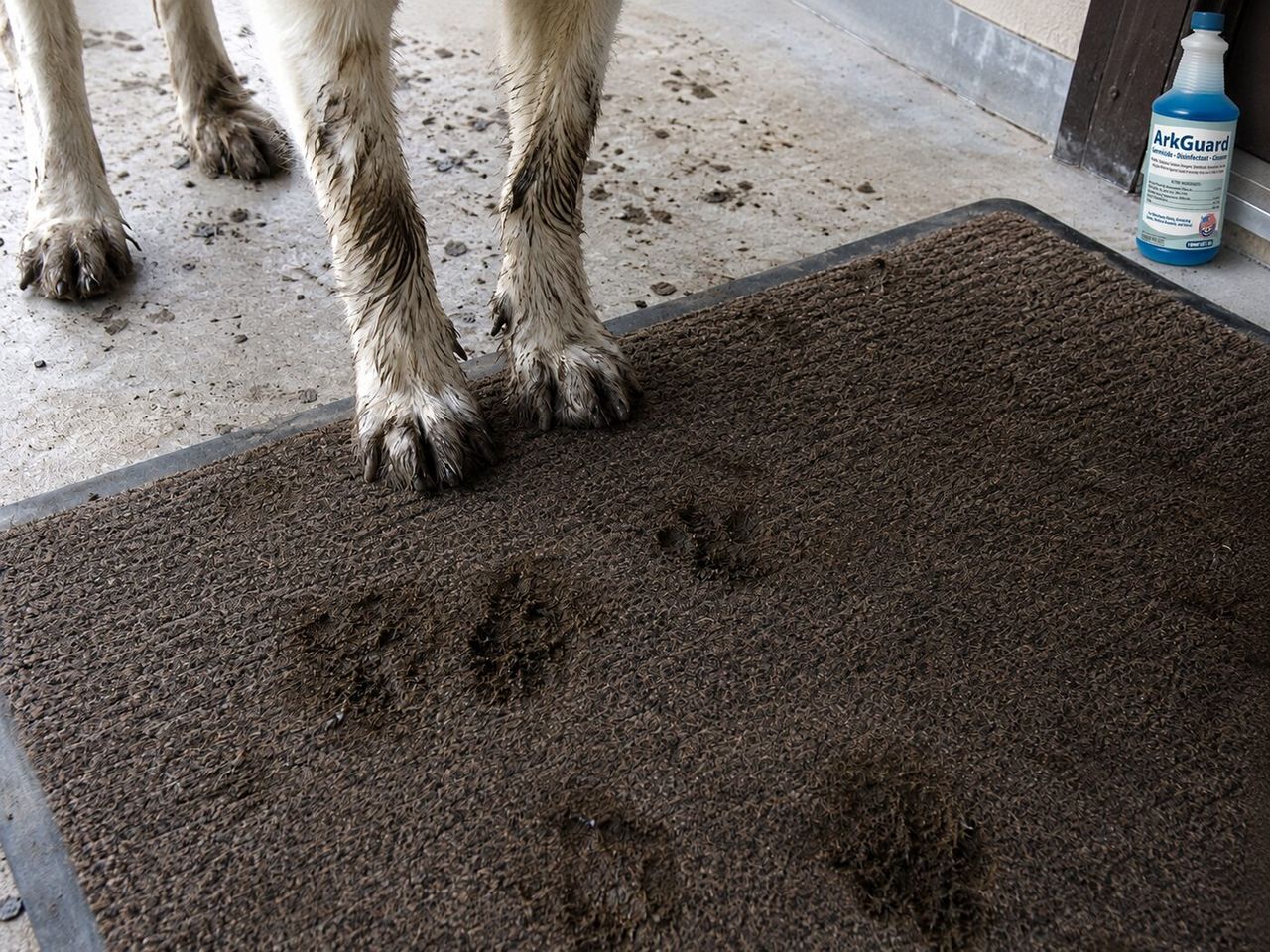
Placement: transitions, not decorations
Put a station at every dirtier-to-cleaner boundary: the front door of a kennel or daycare, the isolation ward threshold (both directions), the whelping room door, and between barns. One bath at the front door of a building whose iso ward has no bath is a moat around a castle with open side gates.
At home, the honest equivalent is simpler: shoe-free past the mud room, a boot tray that gets sprayed weekly, and the high-alert rule during a puppy’s pre-vaccine window.
Hardware that survives real use
A shallow rubber or heavy plastic pan with sides tall enough to hold an inch plus splash; a scraper mat bolted or weighted in front; a long-handled brush hanging beside it for stubborn treads; and a remake schedule taped to the wall with initials — the tape is what converts equipment into a program. Pans get scrubbed at remake time (they’re a hard surface too); winter operations move the station inside the threshold so the solution stays liquid, because frozen solution has zero contact time.
Cost math, since the remake rule is where budgets flinch: a daily one-gallon remake at 4 oz/gal uses about $0.30 of concentrate from a gallon jug. The disease it filters bills differently.
Frequently asked
What's the correct foot bath dilution and depth?
2 to 4 oz of ArkGuard per gallon of water, maintained at one inch deep, with shoes scraped clean first and 3 minutes of wet contact for full effect. Remake the bath daily or as soon as it's visibly dirty.
Do foot baths actually work?
A maintained foot bath on scraped boots measurably cuts what walks through a door; a mud-soup foot bath is theater. The difference is the scrape mat before it and the daily remake — the discipline, not the pan.
Where should foot baths go?
Every transition from dirtier to cleaner: facility entrance, isolation threshold, whelping room door, barn entries between buildings. In homes, a boot tray plus shoe-free rule at the mud room does the same job.